The Hidden Costs of Batteries: Why Purchase Price Is Only Part of the Equation
When evaluating power solutions for material handling operations, the purchase price is often one of the first numbers considered. But the initial price of a battery tells only part of the story.
For high-throughput operations, the real cost of battery-powered equipment can extend well beyond the battery itself. Labor, downtime, declining performance, floor space and operational inefficiencies can all add costs that may be less visible on a balance sheet, but very real on the warehouse floor.
That’s why comparing power solutions requires looking at total cost of ownership and total impact on operations.
What’s Below the Surface?
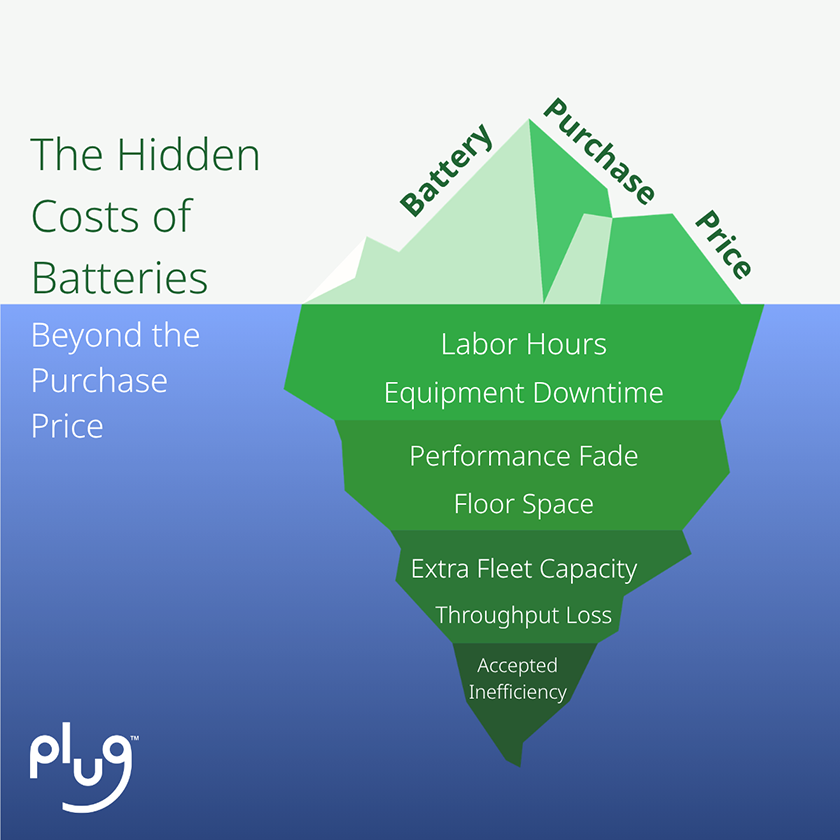
Like an iceberg, some of the most significant costs associated with batteries can sit below the surface.
Labor Hours and Equipment Downtime
Battery charging and changing can require employees to stop productive work, travel to designated areas and spend time managing batteries rather than moving goods. Depending on the operation, equipment may also be unavailable while batteries charge or are swapped.
At scale, even small interruptions can add up across shifts, vehicles and facilities.
Performance Fade
Battery performance can change as charge levels decline and batteries age. For operations that depend on consistent equipment performance throughout a shift, that variability can affect productivity and make fleet planning more complex.
Floor Space
Battery rooms, charging infrastructure and battery storage all require space. In a warehouse or distribution center where every square foot has value, dedicating space to power infrastructure can represent an overlooked operational cost.
Extra Fleet Capacity
If equipment needs to be taken out of service for charging or battery changes, an operation may require additional vehicles or batteries to maintain the capacity it needs. That means the cost of powering a fleet can extend beyond the equipment actively moving products at any given moment.
Throughput Loss
Ultimately, labor interruptions, downtime and inconsistent performance can affect what matters most: throughput.
For high-volume operations, minutes matter. Delays that appear small at the individual vehicle level can become significant when multiplied across hundreds of vehicles, multiple shifts and thousands of operating hours.
The Cost of Accepted Inefficiency
Perhaps the hardest cost to quantify is the one that has simply become part of doing business.
Processes built around charging schedules, battery changes, equipment availability and other constraints can become so routine that their impact is no longer questioned. But “the way it’s always been done” doesn’t necessarily mean it’s the most efficient way to operate.
That is where hydrogen fuel cells offer a fundamentally different approach.
Plug’s GenDrive fuel cell solutions are designed for material handling operations that demand high utilization, providing fast fueling, consistent power and the ability to keep equipment moving without lengthy battery charging cycles or battery swaps.
For customers evaluating batteries against hydrogen fuel cells, the question shouldn’t simply be:
What does the power source cost to purchase?
It should be:
What does it cost to operate the entire fleet?
When labor, downtime, performance, space, fleet requirements and throughput are included in the equation, the picture can look very different.
The purchase price is visible. The operational costs underneath it deserve just as much attention.